IDentity: IC avatar
Initiation Challenge
To manifest your IDentity profile, you must prove that you are not a zombie. This is unlike a captcha for the bots; the challenge is to demonstrate the ability to design and perform a basic cognitive ritual. This process involves four steps:
- State the intent: Formulate a meaningful goal for yourself.
- Summon the attractor: Use your imagination to invoke a symbol.
- Charge: Link the symbol to an energy source, such as a highly desirable or inspiring outcome.
- Launch: Establish a bridge to a subconscious driver.
If you are familiar with chaos magic, this sounds similar. Indeed, we frame our "cognitive ritual" as a crossover between "magic practice" and "objective experimentation." While science can observe the mechanics of the process, the two final steps cannot be "objectified," as they require a direct, actionable connection to the subjective realm (where we can only perform correlational studies).
Simple Example
Suppose you are a "workaholic" struggling to find a balance between your duties and your leisure. You declare this as your intent.
To summon the attractor, you must look within to find a symbolic representation rooted deeply in your perception. Clear your mind and wait for the first image to emerge. An image of a scale pops into view: the right plate is red (duty), the left plate is blue (leisure). You notice: right & red – it feels significant = heavy, while left & blue feels... undervalued?
Next, you charge the symbol by visualizing the best possible outcomes: more time with family, improved health, a more vibrant life.
Finally, you must activate the bridge. You don't even know how to start. In your imagination, you try to push the left plate down – it feels almost impossible at first – the right side is too heavy... Then, realization strikes: you made the right side heavy... allowing the wrong things to settle on the right plate. Suddenly, you see it clearly. You are now able to filter the excess away. You feel it moving...
Here is where the magic happens: you don't need to know how. In fact, it is impossible to put the "how" into words. The key lies in observing your summoned attractor. You invited it, it arrived, and it allowed you to interact with it. A hidden door exists, and that door is open.
Most of us have experienced this. Sometimes, you need a solution but have no idea how to find it. You simply keep your intent in the back of your mind, reminding yourself of it occasionally. Then, one day, the solution arrives, seemingly out of nowhere. That is the bridge: all you need to do to claim it is maintain the awareness that the door exists. You cannot address this through language alone – and that is not a problem at all.
In "traditional magic," to launch your sigil, you must "load" it into your subconscious through forced "forgetting." Instead, we do something more subtle yet powerful: we cut the visual feedback. You will learn to draw it "blind," relying solo on the grid.
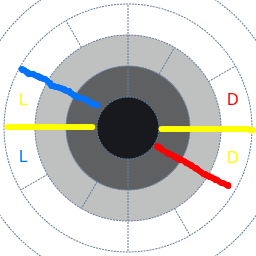
This is a simple sigil drawn for this example within the grid offered by our initiation-challenge.
Are you ready for yours?
The Initiation challenge probes several cognitive metrics, such as attention span and memory. It is not an easy pass.
No personally identifiable information is required.
The Sigil drawing guide
You already use sigils (your signature for one), the corporations use them (logos) – old magic goes on.
To succeed, you must simplify your vision into a meaningful, sharp representation – a task that requires significant internal engagement. Every login will reinforce your new skills (till the next challenge arrives).
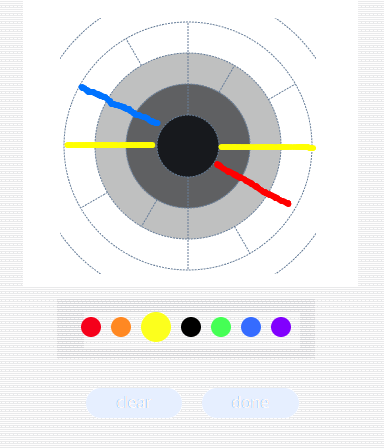
Step I: Encoding your Intent
First, you will define your lines. Lines are difficult to produce with precision. Furthermore, the system must learn to recognize you by your unique drawing style; therefore, both order and direction matter (e.g., a left-handed vs. a right-handed stroke).
This is your secret – you must be able to reproduce this pattern using the grid as your guide.
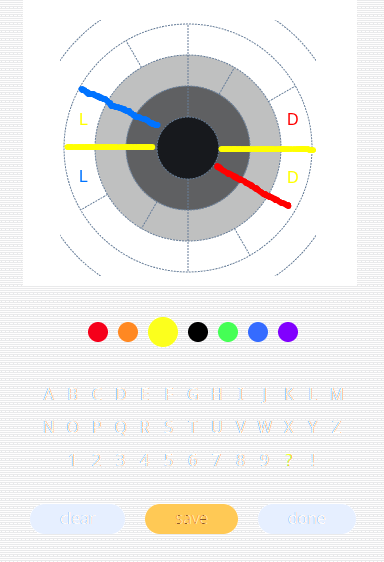
Step II: Setting the Anchors
Next, you will establish your markers. While these are simpler to reproduce, the sequence remains critical – they often represent the initial characters of your intent.
Once finished, click save to create your local "crib note."
(You will need one.)
Step III: The Blind Trial
Finally, you will practice the entire sequence blind – without visual feedback while drawing. (Use the palette's visual feedback to confirm your settings.)
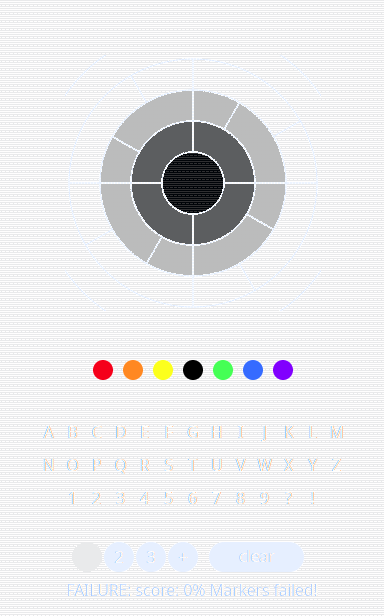
This is a true cognitive challenge. Three successful attempts will complete the trial. Failure is okay; however, if your drawing style provides inconsistent signals, the system will penalize you by requesting an additional attempt. (The example below shows the scenario with the failed first attempt.)
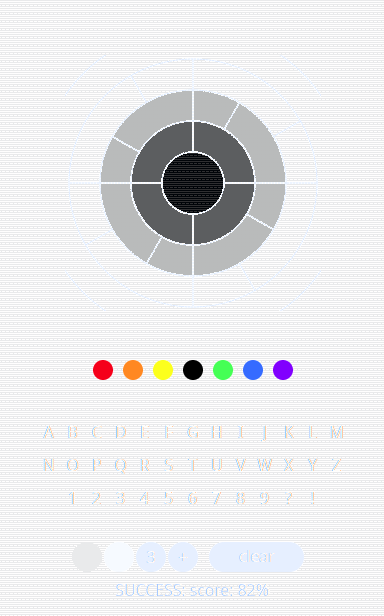
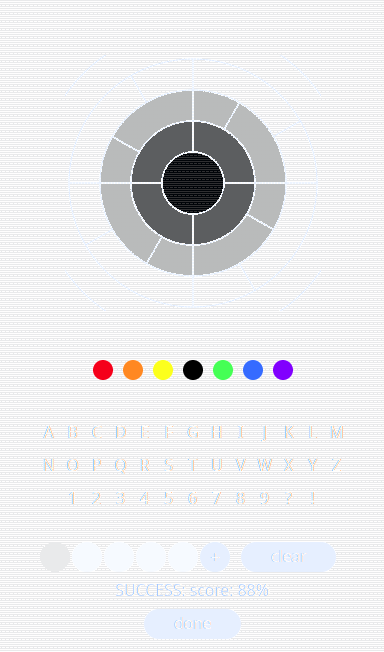
Efficiency Note: the markers go after the lines – is optimal for the speed, however, you may bundle them together if they have the same sequence, a blue line has a corresponding blue marker, followed by a red line with its corresponding red marker, you can chose the color once for both. This allows you to move faster.
On Success: The clicked button will turn silver, counting toward your goal.
On Failure: The button will vanish, and a failure message will appear.
Expanding Attempts: If you exhaust your numbered buttons, click the [+] button to log your completed additional attempt.
Once the done button appears, you may either continue practicing or proceed to Login.